
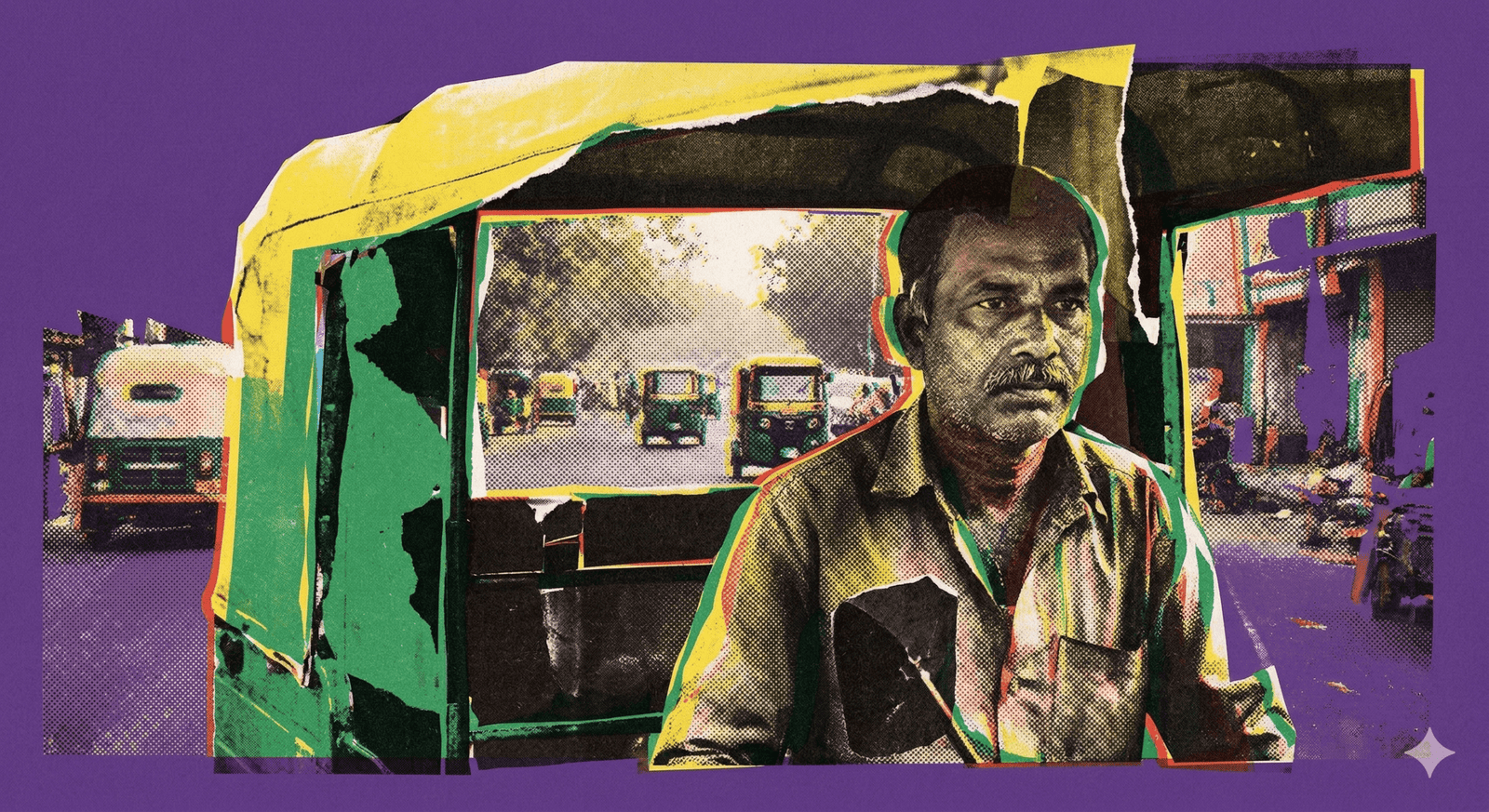
04 Mar She is My Hope: A Father’s Story from Delhi’s Streets
I usually have deep discussions with people I meet during day-to-day affairs. I want to document some of them but most of the times I fail. This one is from my recent interaction with an Uber auto driver on 3 March 2026. This Holi, I sat and wrote it.
It was Tuesday morning. I was rushing to reach my office. I booked an Uber auto and met the driver, Mr. Shibu (alias). The road was comparatively free — maybe many people were working from home or visiting their hometowns to celebrate Holi. As usual, to initiate a discussion with the driver, I asked him, “Are you from Mainpuri?” He said he was from Chennai. I said, “Most of the auto drivers in this locality are from Mainpuri, Etah, and Etawah.”
Our conversation progressed and he described how he ended up becoming an auto driver. Before the COVID-19 lockdown, he used to work in a pharma company but lost his job. However, he had earlier applied for an auto license and got it just a few days before the lockdown was imposed. His initial plan was to sell it if he got a good price. But things had to happen differently. As he lost his job due to the COVID lockdown, he chose to drive an auto to make his living, and soon realized it was good enough to get going — so he decided to keep it and continue.
He has a daughter who is appearing for her 10th board exam. He insisted that people in South India take risks to educate their kids and even sell their ornaments for it. I asked him what grade he had studied up to. He said he was a matriculation dropout. I asked “why.” He said his father had migrated from rural Tamil Nadu and was not aware of the importance of education. He got him enrolled in a government school, but the environment was not conducive. His father used to encourage them at home to study well, but none of his siblings paid attention. Now, however, all his siblings’ children are studying well — and all of them go to private schools. His daughter has also attended DAV School and goes for private tuition that costs him Rs 80,000 yearly, and the school fee is nearly Rs 5,000 per month.
He has his own house in Shakurpur, Delhi — a three-storeyed building where all the brothers live on different floors. He said that driving an auto is enough to feed and educate his children, but buying or constructing a house in Delhi is no longer possible. I mentioned that I know a few people in Delhi who were able to buy land and construct a house. He countered that yes, it was possible earlier, but it is becoming tougher now. On top of that, the auto business is getting hit by the introduction of motorbike taxi services offered by different companies, and taxi has become popular because of Ola and Uber.
Our conversation then turned to how girls and boys take responsibility differently. I mentioned that girls are generally more understanding and quicker to take responsibility. He agreed, but added that the one rising concern about girls is that as they grow up, there is a constant worry that they may run away with a boy. He also noted that boys take responsibility too, but they think differently.
I asked, “What does your daughter wish to become?” Unenthusiastically, he said she has an interest in humanities, and when he asked her about a career in that, she said lawyers or some other profession.
He added that she is just finishing her 10th and he doubts she can visualize well yet, but she has done well in her pre-board exams and he is confident she will do well. “She is my hope,” he said, “and I want to educate her to my capacity.” He again stressed that education is very important and people from South India try to educate their children to their level best.
I asked how far his village was from Chennai railway station. He said it is not Chennai itself but nearly 10–12 hours away by train. They do not go frequently but usually travel by the Tamil Nadu Express, and the village is close to the railway station. I missed the name of the station.
This 20–25 minute journey was full of information. The ride ended, I paid the fare and thanked him.
Shibu’s story resonated with me personally. My father too used to say the same thing — to study well — but like Shibu, I missed the environment in school. I could not solve basic maths or comprehend texts to the level of my grade. I used to go to school but my learning was zero. What we should not miss is that providing quality learning and a conducive environment in schools is more crucial than just pushing children to study. It also appears that government schools, even in India’s capital, are failing to provide quality education and environment, and parents who can afford it are preferring to send their kids to private schools. Even by a rough estimate, Shibu is investing nearly Rs 1.5 lakh per annum just as tuition fee for his single daughter. Quality education is becoming difficult to access, especially when the annual income of the bottom 50% of India’s population is nearly Rs 70,000.
The second thing that stayed with me is that most parents in India still worry about girls, particularly about their affairs with boys, which is quite natural at a young age. But we definitely need ways to instill confidence in parents through counselling and awareness. Because I have seen that many parents stop the education of their daughters due to such fears.
Anyway, if you have reached this last line, such stories make me learn new things and make me a better human. I hope there is something here for you too. Let me know what you think of Shibu’s story. Thank you.
The featured image was generated using AI.